

PSA 10 vs raw — is grading worth it?
- Cheapest PSA service now
- $59.99/card (Standard)
- Worth it (clean copy)
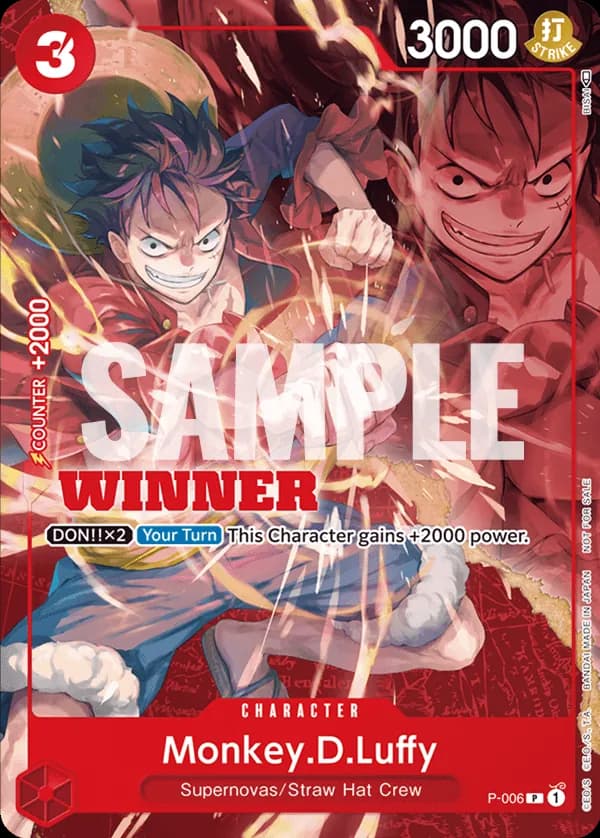
- P-006 WINNER · WSJ55 Luffy · OP13/OP16 manga
- Rarely worth it
- EB03 Nami promo · Robin SP · Magazine Luffy
- Never worth it
- P-043 WSJ foil · base OP13-108 Bonney
Verdict — A PSA 10 selling for 2× the raw price does not make grading worth it. At PSA's current $59.99 minimum, what matters is the dollar gap between raw and PSA 10 — and how often your copy will actually come back a 10.
The short answer: grading a One Piece card is worth it only when the dollar gap between its raw price and its PSA 10 price is big enough to cover PSA's fee many times over. As of 17 September 2026 PSA has paused its Value tier, so the cheapest service is Standard at $59.99 a card (about $68 with shipping). On real September sales, that makes grading a clear yes for cards like the P-006 WINNER Luffy (raw ~$180, PSA 10 $585) — and a clear no for cards like the P-043 WSJ foil (raw ~$57, PSA 10 ~$135), even though its PSA 10 sells for more than twice the raw price.
This is independent analysis of physical collectibles — not financial advice. We don't sell cards and we don't grade them, so we have no stake in whether you submit.
The one number that decides it
Most "is it worth grading" advice stops at the ratio: a PSA 10 sells for 3× raw, so grade. That ignores the two things that actually decide it.
- The fee is fixed, not a percentage. PSA charges $59.99 whether your card is worth $5 or $500 (up to $1,000 insured value; pricier cards need a pricier tier). A $2 card and a $600 card pay the same fee.
- You don't choose the grade. You send a card hoping for a 10. You get whatever comes back.
So the useful question is: how often does this card need to come back a PSA 10 for grading to pay? We call that the break-even 10-rate. If you think your copy is cleaner than that, grade it. If not, sell it raw.
The maths, in one line: break-even 10-rate = grading cost ÷ (PSA 10 price − raw price, after 13% selling fees). It assumes a copy that misses a 10 still sells for about its raw price — which is generous, as the first card below shows.
Real cards, real September prices
Every price is a real sale for that exact print, with the date. Grading cost is PSA's fee for the card's PSA 10 value plus $8 round-trip shipping allocated per card.
| Card | Raw | PSA 10 | PSA 10 ÷ raw | Grading cost | Break-even 10-rate |
|---|---|---|---|---|---|
| P-006 WINNER Luffy (EN) | ~$180 (TCGplayer NM, 27 Aug; eBay $150, 29 Aug) | $585 (eBay, 13 Sep) | 3.3× | $67.99 | 19% |
| WSJ 55th Anniversary Luffy Gear 5 (JP) | ~$263 (eBay $231–306, 29 Aug–6 Sep) | $630 (eBay, 10 Sep) | 2.4× | $67.99 | 21% |
| OP13-120 Sabo manga (EN) | ~$601 (eBay + TCGplayer, 2–11 Sep) | $980 (eBay, 1 Sep — one sale) | 1.6× | $67.99 | 21% |
| OP16-065 Sakazuki manga (EN) | ~$871 (eBay + TCGplayer, 30 Aug–11 Sep) | $1,825 (eBay, 30 Aug — one sale) | 2.1× | $207 (Express tier) | 25% |
| EB03-006 Nami promo (JP) | ~$99 (SNKRDUNK cond. A) | ~$214 (SNKRDUNK, 11 sales, 3–13 Sep) | 2.2× | $67.99 | 68% |
| EB03-055 Nico Robin SP (JP) | ~$565 (SNKRDUNK + eBay) | ~$660 (SNKRDUNK, 10 sales, 5–14 Sep) | 1.2× | $67.99 | 82% |
| ST21-014 Magazine Vol.20 Luffy (JP) | ~$116 (SNKRDUNK cond. A, 3–11 Sep) | ~$204 (SNKRDUNK, 15 Sep; eBay $191–228, 13 Sep) | 1.8× | $67.99 | 89% |
| P-043 WSJ foil King Luffy (JP) | ~$57 (SNKRDUNK cond. A, 3–5 Sep) | ~$135 (SNKRDUNK, 7 sales, 12–14 Sep) | 2.4× | $67.99 | 100% |
| OP13-108 Jewelry Bonney SR (EN) | ~$2 (TCGplayer + eBay) | ~$41 (eBay $40.28–42.44, 8–12 Sep) | 20× | $67.99 | impossible |
Two of those PSA 10 prices (Sabo and Sakazuki) rest on a single sale each, so treat those rows as directional.
What the table actually says
Grade it — if your copy is clean. The P-006 WINNER Luffy, the WSJ55 Gear 5 Luffy and the OP13/OP16 manga rares all break even at roughly a one-in-five PSA 10 rate. Each has a several-hundred-dollar gap between raw and PSA 10, so the fixed fee is small against it. A well-centred, clean-surfaced copy should clear that bar.
Rarely worth it. The EB03-006 Nami promo needs a 10 about two times in three. The Robin SP needs four in five, because its PSA 10 barely sells above the raw. The Magazine Vol.20 Luffy needs almost nine in ten. That last one matters: in July our Avoid call on its PSA 10 described cheap grading as an open arbitrage pumping PSA 10 supply. At PSA's current $59.99 minimum, most of that arbitrage has closed.
Never worth it. The P-043 WSJ foil only breaks even if every copy comes back a 10 — a PSA 10 at 2.4× raw still isn't enough, because the gap is only ~$78. And the base Jewelry Bonney SR is the purest example of the ratio trap: its PSA 10 sells for 20× raw, yet even a guaranteed 10 loses money, because a $41 slab can't pay a $68 grading bill.
A miss costs more than you think
The break-even figures assume a card that misses a 10 still sells for its raw price. Often it doesn't. The P-006 WINNER Luffy is the example: a PSA 9 sold for $142.50 on 13 September, below the ~$180 raw price. Price that in and its break-even 10-rate rises from 19% to about 26%. For a modern card, a 9 is frequently worth less than an ungraded copy — buyers pay for the 10 or for the chance of one.
How to use this on your own card
- Price both versions from real sales of your exact print. Stamp, foil, language and set all change the price. A blended "P-043" price is useless — that one number covers four different cards.
- Take the dollar gap, not the ratio: PSA 10 price minus raw price.
- Check the fee tier. Up to $1,000 insured value is $59.99; up to $1,500 is $79.99; up to $2,500 is $199. Declare at what the card is worth as a PSA 10.
- Work out the break-even 10-rate with the formula above.
- Be honest about your copy. Look at centring, the surface under a light, and edge whitening on the foil. If it's not obviously clean, assume a lower chance than you'd like.
Or skip the arithmetic and use the grading-EV calculator, which now runs on PSA's current fees.
Sources and method
- PSA fees: PSA's trading-card grading page, checked 17 September 2026. Value services were marked "temporarily paused"; Standard $59.99 (insured to $1,000, 90–100 business days), Priority $79.99 ($1,500), Express $199 ($2,500).
- Sold prices: eBay sold listings, TCGplayer sales for the exact product, and SNKRDUNK accepted sales (condition A for raw). Every price is one print, never a card-number average. Each card page links the individual sales behind its current price.
- Selling costs: 13% marketplace and payment fees, and $8 shipping allocated per card — the same assumptions our calculator uses.
- Disclosure: the founder holds raw copies of several cards in this table, including the P-006 WINNER, the WSJ55 Luffy, the EB03-006 Nami, the Magazine Vol.20 Luffy and the Bonney. Each position is disclosed on its card page. Our method: how we price cards.