
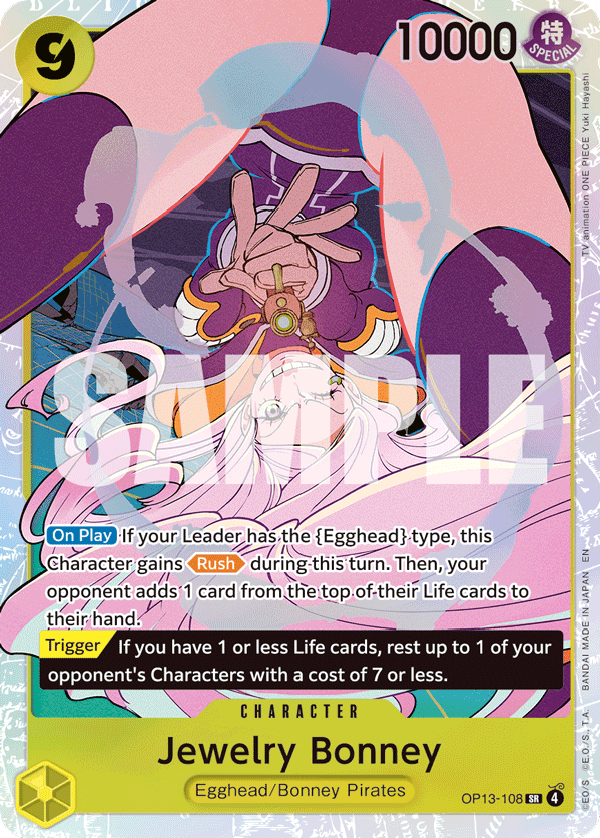
The short answer: The Bonney One Piece card everyone's asking about is the SR (Super Rare) Jewelry Bonney — OP13-108 ("Carrying On His Will"). Its raw price is creeping up even though the card is cheap on every mainstream tracker and isn't a competitive staple — so this isn't a fundamentals move. What's actually being bid up is the PSA 10, and the likely engine is a graded-card buyback loop: inflated graded comps feed the price data that retailer trade-in programs (like GameStop) pay against, which creates grading-arbitrage demand that drags the cheap raw up behind it. Our read: the raw's real, liquid value is far below the spike — we're not chasing it.
This is observational market analysis — not an accusation of any party, and not financial advice. The goal is to help you tell a real rally from a manufactured one before you spend money.
First, the data: this isn't a fundamentals move
If OP13-108 had become a must-play, you'd see it in both the price and the meta. You don't:
- It's cheap on the mainstream trackers. At the time of writing, raw OP13-108 sits around $1.71 on TCGplayer (via OPCardList), about $3.75 median on Limitless, and roughly €0.25 on Cardmarket. Any "rise" is happening off a tiny base.
- It's not a staple. Bonney is a popular leader/archetype shell, but the SR OP13-108's effect is conditional and tied to Egghead leaders — narrower demand than a universally played card.
- The decklist signal is the archetype, not this card. Bonney showing up in results reflects the leader being relevant, not evidence that this specific SR is the driver.
Translation: small buying pressure can make a cheap, thinly-traded card's chart look lively without any real shift in demand.
What's actually moving: the PSA 10, not the raw
Look at where the big numbers are. Raw copies are a few dollars; PSA 10 copies are selling around $1,150–1,450 (some asks run higher). A graded card worth hundreds of times the raw is the whole story. The action is in the graded market — the raw is just being pulled along behind it.
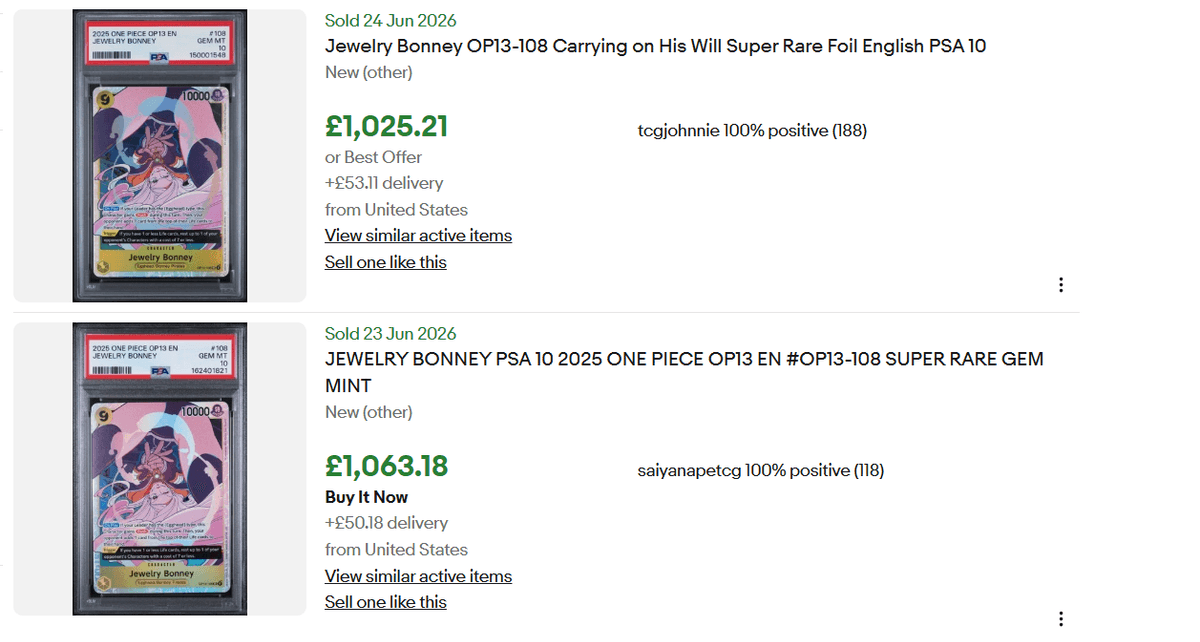
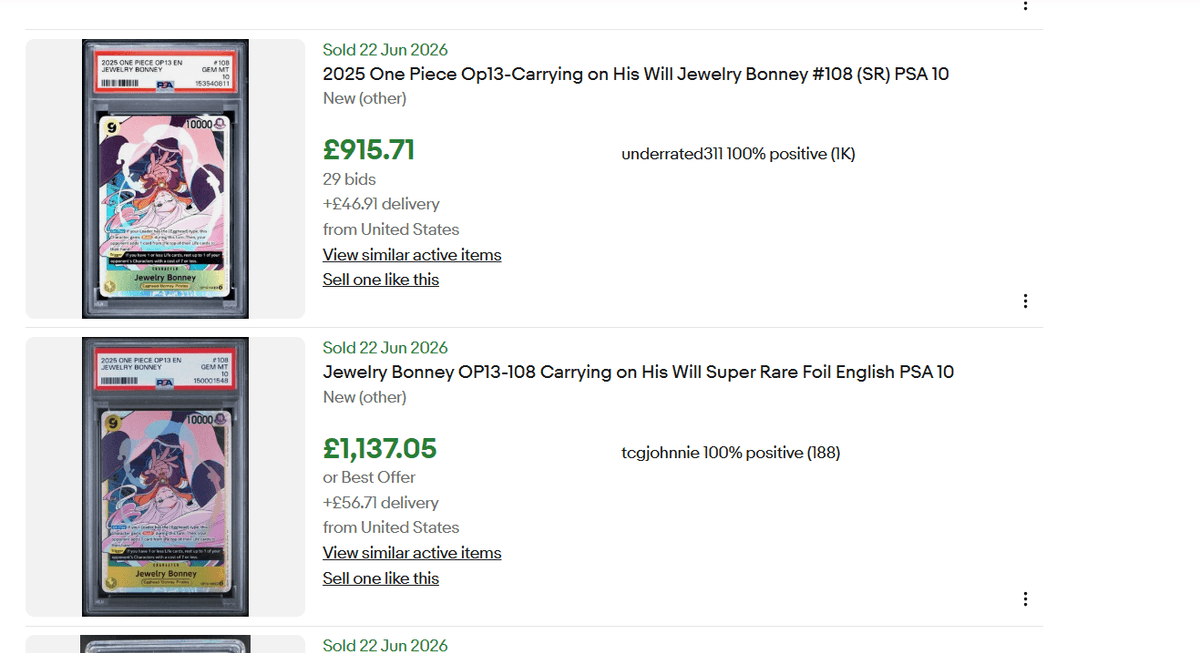
Recent PSA 10 sold comps — OP13-108 (eBay, Jun 2026):
| Sold | Price | ≈ USD | Listing |
|---|---|---|---|
| 24 Jun 2026 | £1,025 | ~$1,300 | Best Offer |
| 23 Jun 2026 | £1,063 | ~$1,350 | Buy It Now |
| 22 Jun 2026 | £1,137 | ~$1,440 | Best Offer |
| 22 Jun 2026 | £916 | ~$1,160 | Auction — 29 bids |
Four separate PSA 10 sales in three days, clustering £900–1,140 ($1,150–1,450) — including a live 29-bid auction, which is a real clearing price, not just an asking number. That's the inflated graded value the buyback loop feeds on, and exactly the froth this post is about. Secondary-market sold prices, not live quotes.
The engine: a graded-buyback comp loop
Here's the part the surface-level "it's just a liquidity spike" takes miss — why inflating a thin graded market can pay for itself.
Several major retailers now run graded-card trade-in / buyback programs. GameStop's is public and specific:
- it accepts PSA 8, 9, and 10 graded cards (not raw),
- prices each card in real time using data "derived in part by Card Ladder,"
- and pays up to a $1,500 cap per card.
Comp aggregators like Card Ladder (and PriceCharting, which monitors essentially every eBay sale) build their numbers from public sold comps. So the chain runs: a few inflated graded sales → the comp aggregators → the price a buyback counter will pay. When a graded card is thinly traded, a small number of high sales can move that comp a long way — and once the comp clears the cap, the program simply pays the cap.
That's a structural vulnerability, not a verdict on anyone: any valuation that leans on thin public comps can be distorted — intentionally or not — by a handful of outsized sales. We flag it because it's exactly the condition a card like OP13-108 is in.
We've generalized this case into a reusable checklist you can run on any sudden move: how to spot a manufactured card pump.
Why the cheap raw gets dragged up
Once a PSA 10 is worth ~$1,500 at a buyback counter, the raw becomes a grading lottery ticket: buy it for a few dollars, grade it, and the upside is the graded price. That grading-arbitrage demand is what bids the raw off its floor — so the raw "spike" is a derivative of the graded dynamic, not collector demand for the SR itself.
That's the distinction that matters for your money: the raw isn't rising because people want to play or collect OP13-108. It's rising because the graded number got interesting.
What OP13-108 is actually worth
- Raw: anchor to where copies consistently sell to many different buyers — on current evidence, low single digits, well below any momentum print.
- PSA 10: a real but thin, possibly inflated number propped up by a small float and the buyback loop. Treat it — and any comp-based valuation built on it — with skepticism.
Our take
We're not chasing the raw spike as momentum — paying a headline price that may not survive contact with real liquidity is how you end up the exit. If there's any rational angle here, it's the cold grading-EV math on a genuinely cheap raw — and even that we hold at low conviction, precisely because the graded comps underwriting it may themselves be inflated. Run the numbers before the hype runs you.
- Run the grading-EV calculator before buying a raw card to grade.
- See the live, dated note in Market Watch.
- Browse more market reads in Market Watch.
FAQ
Is GameStop being scammed? We're not alleging that. We're describing a structural fact: comp-based buyback programs that price off thin public markets can be distorted by a few inflated sales. That's a vulnerability worth understanding as a buyer — full stop.
Should I buy raw OP13-108 to grade it? Only if the grading EV is positive on conservative graded prices — not the hyped ones. Use the calculator, assume a realistic PSA 10 rate, and discount the graded comp for how thin it is.
Is raw OP13-108 a good "investment"? Its collector fundamentals are thin and its effect is niche. Most of the current price is the graded/buyback shadow, not durable demand — size accordingly.
Sources
- GameStop trade-in program — graded-card buyback (PSA 8–10, priced off Card Ladder data, $1,500 cap)
- OPCardList — OP13-108 — TCGplayer raw-price reference
- Limitless TCG — OP13-108 — median price and meta data
- PriceCharting — One Piece cards — eBay-sale-based comps
- PSA 10 sold comps — eBay, 22–24 June 2026 (table and screenshots above)
Observational analysis of public market activity. Not an accusation of any party, and not financial advice. Card values are approximate secondary-market estimates, not live quotes.